








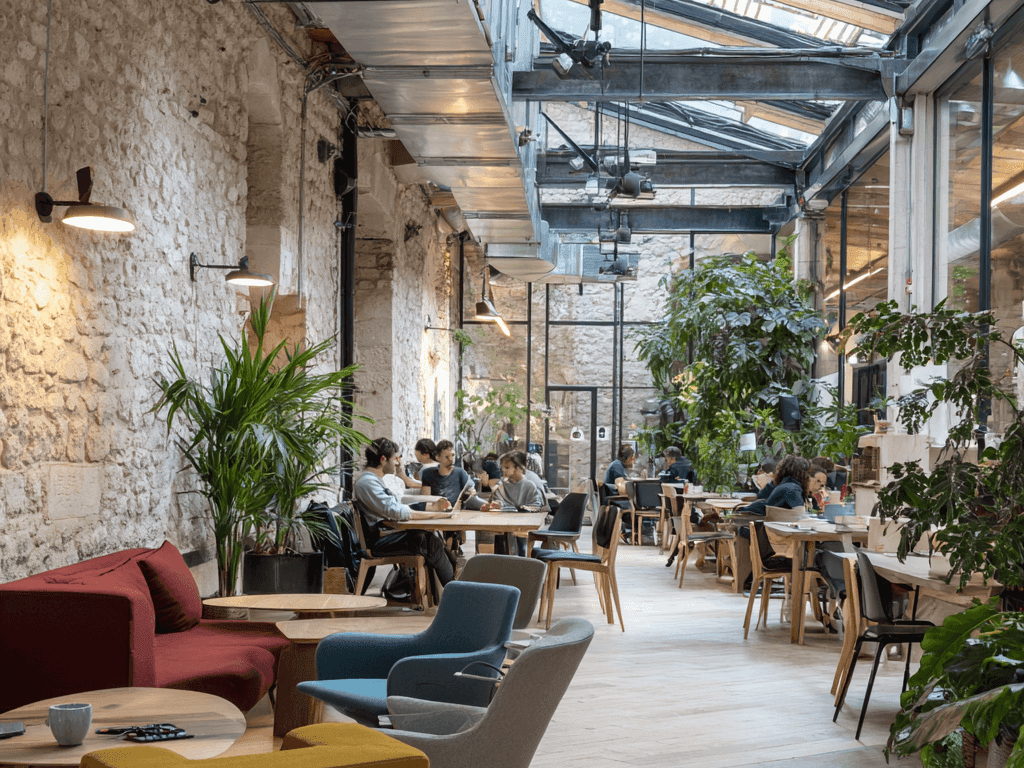
Big question. You've got two hours! On a more serious note, for a long time, coworking was seen as simply a practical device for the self-employed: an à la carte, flexible office, far removed from the traditional corporate model. But as working patterns evolve and telecommuting takes root, what was once a marginal alternative has become a societal phenomenon. Today, many organizations see it as more than just a real-estate service; they see it as a space capable of restoring value to work itself and re-engaging teams. But what exactly is this "value" that coworking claims to restore? And can we really speak of a renewal of the bond at work? We tell you all about it.
Coworking: a response to isolation and the dilution of the collective
The first benefit of coworking is perhaps the most obvious: it brings back human presence where telecommuting had stretched bonds to the point of fragility. For while telecommuting offers autonomy and flexibility, it also isolates, sometimes brutally. Coworking is a response to this silent weakening of the collective. These spaces reintroduce spontaneity, informal exchanges and the social density that is often lacking in an organization split between home, office and screens.
For many employees, working in a coworking or flexible office space means more than just having a chair and a connection. It's about finding an environment where you feel surrounded, supported and sometimes even inspired. It's a paradoxical situation, since sometimes people working for companies with large offices feel paradoxically more connected to the coworking community than to their own colleagues. The location thus becomes a social catalyst that the company no longer always offers. This is made all the more possible by the fact that these spaces also benefit from programming that animates the collective and connects members to one another.
A space that rehabilitates intention and meaning
Coworking is not just a physical environment. By moving away from a standardized location to a chosen space, often warmer, more aesthetically pleasing and more functional, coworkers restore meaning to their activity. They reconnect with what they do, why they do it and how they want to do it.
Choosing a coworking space is never neutral. It means that you no longer occupy an office out of obligation, but are looking for an environment conducive to concentration, creation and interaction. Coworking thus values work not as a presence, but as an intention. Where the traditional office can sometimes crush the individual under its uniformity, coworking introduces personalization, freedom, and thus a form of rediscovered value.
Coworking, a laboratory for a more horizontal way of working
What sometimes attracts people to coworking is not just the furniture or unlimited access to coffee. It's the atmosphere, the posture, the freedom and the sense of flattened hierarchy. In these places, titles, status and salary levels fade away in favor of a more horizontal sociability. Coworking puts the sometimes cumbersome rituals of the corporate world at bay , and encourages more spontaneous interaction.
This horizontality changes the way work is produced. People are more willing to share ideas, to ask for help and to speak up.
Some managers even see it as fertile ground for encouraging innovation. By exposing workers to other profiles, other professions and other professional cultures, coworking creates positive friction. It also puts back into circulation a fundamental value of work: the ability to learn from each other.
A model that questions the value of contemporary work
But can we really say that coworking "restores value" to work? It all depends on what we mean by value. If we're talking in terms of raw productivity, the answer is nuanced: coworking isn't always the quietest or most structured place to work. On the other hand, if we consider value in terms of meaning, social ties, professional identity or creative dynamics, then yes: coworking restores dimensions to work that telecommuting had sometimes erased, and that traditional offices no longer always manage to embody.
Coworking rehabilitates choice, the voluntary relationship with the workplace. It puts the individual back at the center, with the freedom to create an environment that suits and stimulates him or her. It reintroduces diversity, porosity and liveliness where the company can sometimes become too rigid. And this is perhaps where its real contribution lies: it rehumanizes work, by inviting everyone to think not just about what they do, but where they do it, and how that place transforms their daily lives.
In this respect, coworking is indicative of a broader aspiration: work that is no longer simply done, but lived. And a job that's lived, of course, is more valuable, isn't it?
-
Why a digital company must also invest in its professional spaces

23/02/2026 Why a digital company must also invest in its professional spaces
It's easy to imagine a digital company operating with almost no materials. Computers, the cloud, video meetings and you're all set. Yet behind this modern image, there are offices, workstations and reception areas. The digital world is based on a very tangible environment.
-
How can the flexible office reconcile real-estate costs and employee expectations?

05/01/2026 How can the flexible office reconcile real-estate costs and employee expectations?
For decades, the office has been seen as an immutable anchor: an assigned position, a fixed desk, a space designed to accommodate every employee from Monday to Friday, between 9am and 6pm. But this model, long considered indisputable, is now faltering under the impact of profound transformations in the world of work. Massive telecommuting, renewed employee expectations, the search for balance and meaning, and economic pressure on real estate are all forcing organizations to rethink their approach.
-
From cost reduction to cultural transformation: the real challenges of the flexible office

15/12/2025 From cost reduction to cultural transformation: the real challenges of the flexible office
Giving up personal office allocation was no longer seen as an upheaval, but rather as an obvious way of reducing costs, improving real estate efficiency and adapting spaces to contemporary uses. However, the companies that have taken the plunge recognize that the reality far exceeds this initial justification. A genuine cultural transformation was underway!