






Meetings don't get much press, especially at a time when everything is done remotely, or when the mix of remote and face-to-face work is not always easy to manage. Synonymous with wasted time, sterile discussions and endless agendas, they often embody the opposite of what they should be: a time for exchange, decision-making... and why not, pleasure. Yet some companies are breathing new life into this professional ritual by injecting it with a dose of creativity and playfulness. The aim: to restore commitment, stimulate ideas and strengthen team cohesion. Here's a look at a discreet but promising phenomenon.
Widespread weariness of corporate meetings
"Another meeting that could have been an e-mail. "This little phrase has been doing the rounds of offices and social networks. And with good reason: according to a LiveCareer study, 71% of working people consider their meetings to be unproductive. It also highlights the fact that the average employee attends 62 meetings a month, and considers half of them a waste of time.
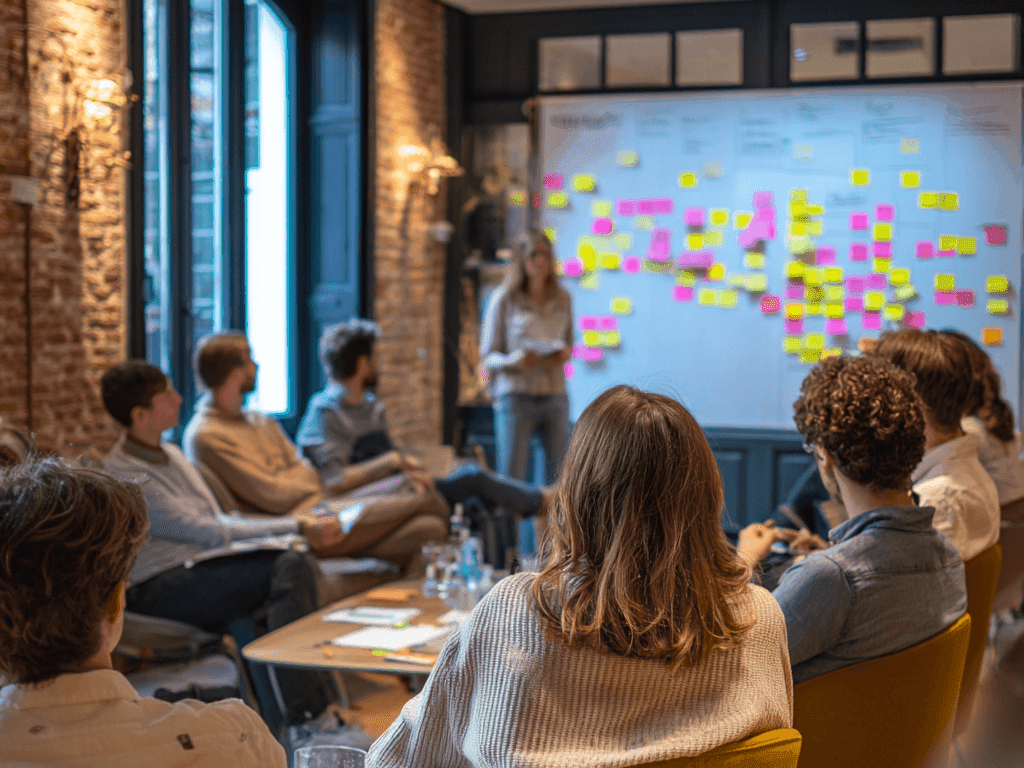
But this may be about to change. Some HR departments, agile coaches and flexible workspaces are experimenting with a different approach: transforming meetings into lively, creative, participative moments. In short, to turn them into real collective moments.
Offbeat ice-breakers, closing rituals, express brainstorming techniques, the role of rotating facilitator... The formats are multiplying to shake up rigid postures. The result: more energy, more participation, more results, even at a distance. Reintroducing play does not mean rendering meetings meaningless.
A management (and cultural) tool
Behind these practices lies a genuine managerial shift. A playful meeting is also a more horizontal meeting. By giving everyone a place to express themselves, and promoting active listening, these formats cultivate commitment without overwhelming hierarchy. A strategic challenge for companies seeking to attract and retain new generations of talent in search of meaning, impact and flexibility...
But beyond management, it's the culture of the entire organization that expresses itself in these choices: do we value audacity? Teamwork? Humor? Learning? Each tool used tells something about the company.
Easy-to-use formats
Contrary to some preconceived ideas, making a meeting engaging doesn't require huge resources or specialized consultants. Just a few ideas can transform the atmosphere:
- The "post-it storm": one topic, two minutes, a flurry of ideas. Visual, rhythmic, effective.
- The "weather round": everyone shares their state of mind in one word or image. Ideal at the start of a hybrid meeting.
- The "what if": what if we imagined an extreme scenario? A technique for shifting thoughts and bringing out new solutions.
- The "silent wall": everyone writes down their ideas or reactions without speaking. A useful way of encouraging introverts.
There's one thing to bear in mind: this isn't a game for the sake of a game, it's a strategy for mobilizing intelligence and breathing new life into these collective sessions.
Far from monotonous powerpoints and sterile monologues, the meeting becomes a lever for performance... but also a space for social bonding, professional pleasure and shared culture.
What if tomorrow, the best way to make a serious decision... was to start with a game?
-
Why a digital company must also invest in its professional spaces

23/02/2026 Why a digital company must also invest in its professional spaces
It's easy to imagine a digital company operating with almost no materials. Computers, the cloud, video meetings and you're all set. Yet behind this modern image, there are offices, workstations and reception areas. The digital world is based on a very tangible environment.
-
How can the flexible office reconcile real-estate costs and employee expectations?

05/01/2026 How can the flexible office reconcile real-estate costs and employee expectations?
For decades, the office has been seen as an immutable anchor: an assigned position, a fixed desk, a space designed to accommodate every employee from Monday to Friday, between 9am and 6pm. But this model, long considered indisputable, is now faltering under the impact of profound transformations in the world of work. Massive telecommuting, renewed employee expectations, the search for balance and meaning, and economic pressure on real estate are all forcing organizations to rethink their approach.
-
From cost reduction to cultural transformation: the real challenges of the flexible office
15/12/2025 From cost reduction to cultural transformation: the real challenges of the flexible office
Giving up personal office allocation was no longer seen as an upheaval, but rather as an obvious way of reducing costs, improving real estate efficiency and adapting spaces to contemporary uses. However, the companies that have taken the plunge recognize that the reality far exceeds this initial justification. A genuine cultural transformation was underway!