






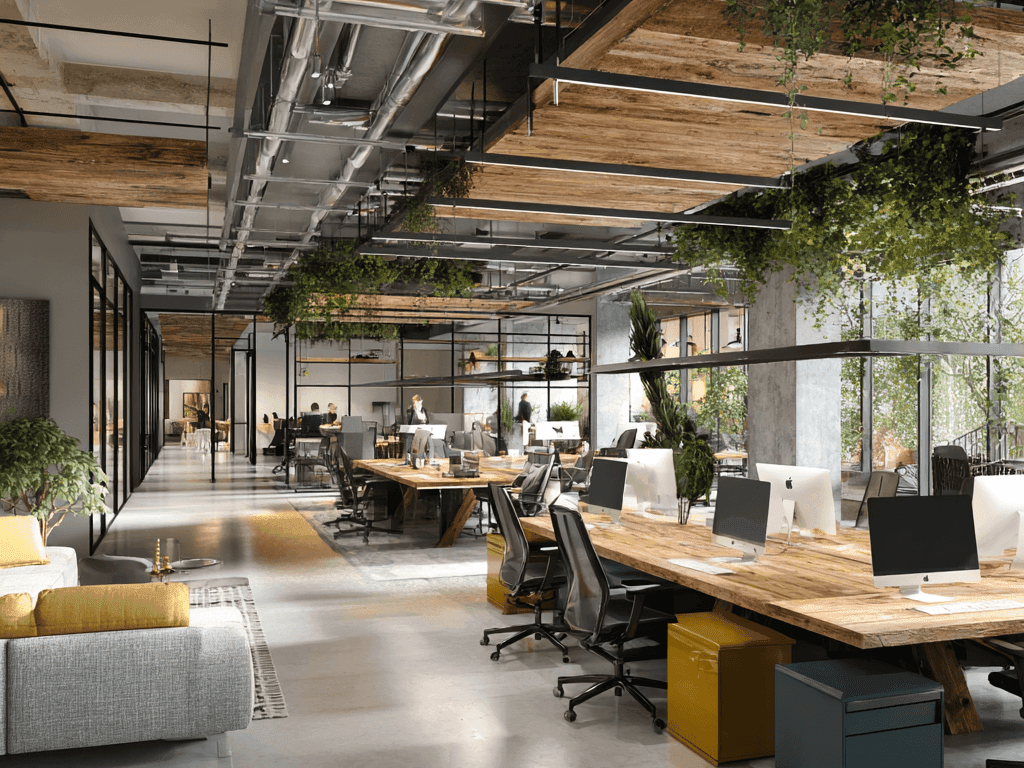
Telecommuting, nomadism, new employee expectations: the revolution in working methods is still underway. However, the time for experimentation is over, and it's now time for flexible workspaces. It's a practice now firmly established in companies. The flex office is a pragmatic response to the changing world of work. Reducing fixed spaces, eliminating allocated offices, rethinking the use of square meters: this organization is winning over more and more companies. But can it really be applied to all structures, all sectors, all teams? The answer is clearly yes, provided that flex office is seen as a lever for change, not an end in itself.
Flex office: a response to contemporary challenges
Flex office is more than just a change of layout. It represents an upheaval in professional habits. In a context where employees alternate between on-site presence and telecommuting, where teams are reconstituted according to projects, it would be illogical to maintain fixed offices systematically unoccupied several days a week. The flex office makes it possible to adapt space to these new dynamics.
It's also a way of rationalizing costs. Less unused space means lower property and energy costs, at a time when sobriety has become an economic and ecological imperative. But above all, flexible spaces transform the office experience: they encourage internal mobility, break down the barriers between departments and encourage new forms of collaboration. They are becoming places for meetings, cross-functionality and creative synergies.
According to the latest analysis by Cushman & Wakefield (April 2025), in Paris, 5% of office space is now devoted to coworking and flexible spaces. The trend is growing, with a diversifying and expanding offer: spaces of over 1,000 m² already account for 41% of the Paris market. A clear sign of the sector's maturity and ability to meet the varied needs of small, medium-sized and large companies.
A model for all sectors, provided it can be adapted
Can the flex office be applied to all companies? The question is worth asking, but it shouldn't obscure the essential point: flex office isn't just for start-ups or tech headquarters. It can be used by large industrial companies, SMEs and local authorities... provided that it is a flexible tool that adapts to the business and the context.
Some jobs, of course, require specific equipment or a continuous presence. But this does not call into question the value of flexible workspaces for the vast majority of employees, particularly in support, sales, marketing or managerial functions. The aim is not to do away with all fixed offices, but to offer a hybrid work environment, designed to provide greater freedom, more collaboration and greater efficiency.
Creating a new work culture
Beyond its practical aspects, the flex office represents a genuine cultural transformation. It invites us to rethink our relationship to work : less territoriality, more sharing; less appropriation of space, more collective use. It's a change of posture, which can sometimes upset habits, but which, when properly accompanied, becomes a driving force for social innovation.
Companies that succeed in this transition invest in support: awareness-raising, training in mobile working, adapted digital tools, convivial spaces to maintain links between colleagues. Because the flexible office must not become a "no man's land", but a real place for professional life, where people come to meet, co-construct and be inspired.
The office of the future is now
The flex office is not just a fad reserved for a handful of innovative companies. It is a concrete response to contemporary challenges : attracting talent, quality of working life, ecological transition, organizational efficiency. Well-thought-out and well-implemented, it can benefit all companies, whatever their size or sector.
Tomorrow's office will no longer be a fixed space, but a flexible, open, living space. The flex office is not just a way of arranging space, it's a new way of working together. And if not all companies have yet adopted it, they will sooner or later. Because the world of work is already on the move.
-
Why a digital company must also invest in its professional spaces

23/02/2026 Why a digital company must also invest in its professional spaces
It's easy to imagine a digital company operating with almost no materials. Computers, the cloud, video meetings and you're all set. Yet behind this modern image, there are offices, workstations and reception areas. The digital world is based on a very tangible environment.
-
How can the flexible office reconcile real-estate costs and employee expectations?

05/01/2026 How can the flexible office reconcile real-estate costs and employee expectations?
For decades, the office has been seen as an immutable anchor: an assigned position, a fixed desk, a space designed to accommodate every employee from Monday to Friday, between 9am and 6pm. But this model, long considered indisputable, is now faltering under the impact of profound transformations in the world of work. Massive telecommuting, renewed employee expectations, the search for balance and meaning, and economic pressure on real estate are all forcing organizations to rethink their approach.
-
From cost reduction to cultural transformation: the real challenges of the flexible office

15/12/2025 From cost reduction to cultural transformation: the real challenges of the flexible office
Giving up personal office allocation was no longer seen as an upheaval, but rather as an obvious way of reducing costs, improving real estate efficiency and adapting spaces to contemporary uses. However, the companies that have taken the plunge recognize that the reality far exceeds this initial justification. A genuine cultural transformation was underway!